We’ve known for a long time that Maastricht — or Mestreech, as they say there — is a great city. We don’t live too far away, so we visit quite often. Recently, however, we headed into the city with a new mission. We wanted to do a city walk through Maastricht that shows off its green side as well as the well-known landmarks. And it worked out pretty well! We mapped out this walking route that combines the main sights with urban nature. Below you’ll find a brief description of a few stops we found particularly special. Download the map and discover, just like we did, that Maastricht is greener than you think.
Parking in a city can be such a hassle! Luckily, we found plenty of parking just outside the ring road at Ambachtsweg/Volksbondweg. You only pay 1.80 euros per hour here, with a maximum daily rate of 7.80 euros. That’s a lot cheaper than the big parking garages, and you’re right on the walking route.
The Jeker Quarter
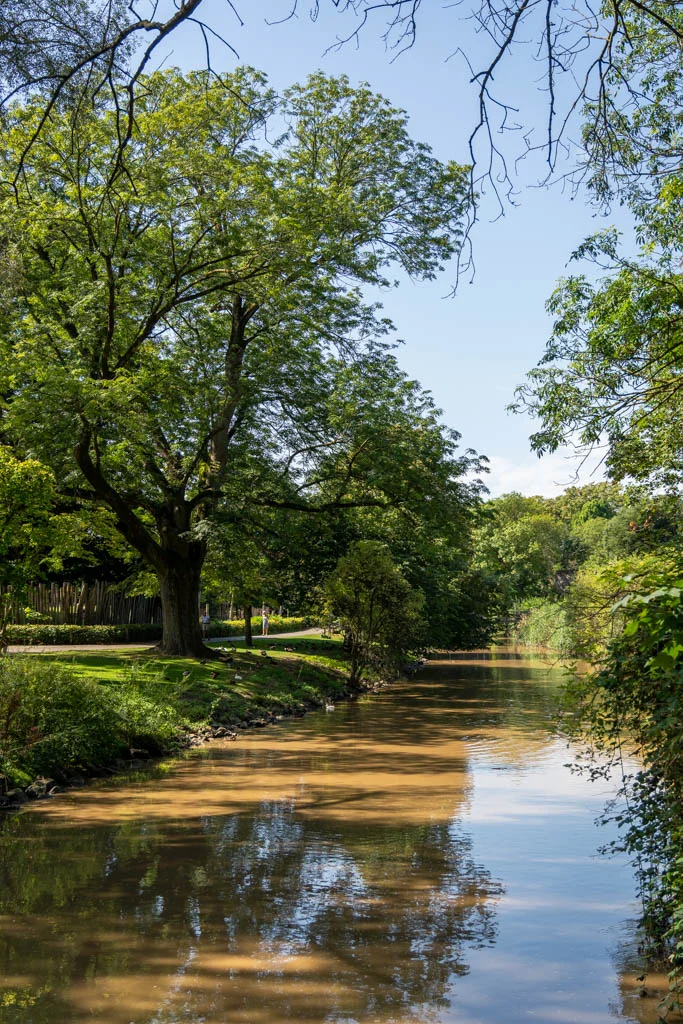
Where better to start a green city walk than in the city park?! Exactly. South of the center, a green belt of various parks stretches out, connected to each other by the Jeker River. On beautiful days, locals lie here on picnic blankets soaking up the sun.
A special sight in the park is the Berenkuil (Bear Pit) (1), which actually housed several bears starting in the 1920s. This was done to lure more tourists to the city. Despite regular protests over animal welfare, the last bear didn’t move out until 1993. In the meantime, the pit has become a work of art. You’ll now find a statue of a lying giraffe, comforted by a young woman, and twelve statues of extinct animal species. Next to the pit is a circular plate with a chair. If you spin it, the girl’s arm moves caressingly over the giraffe’s neck.
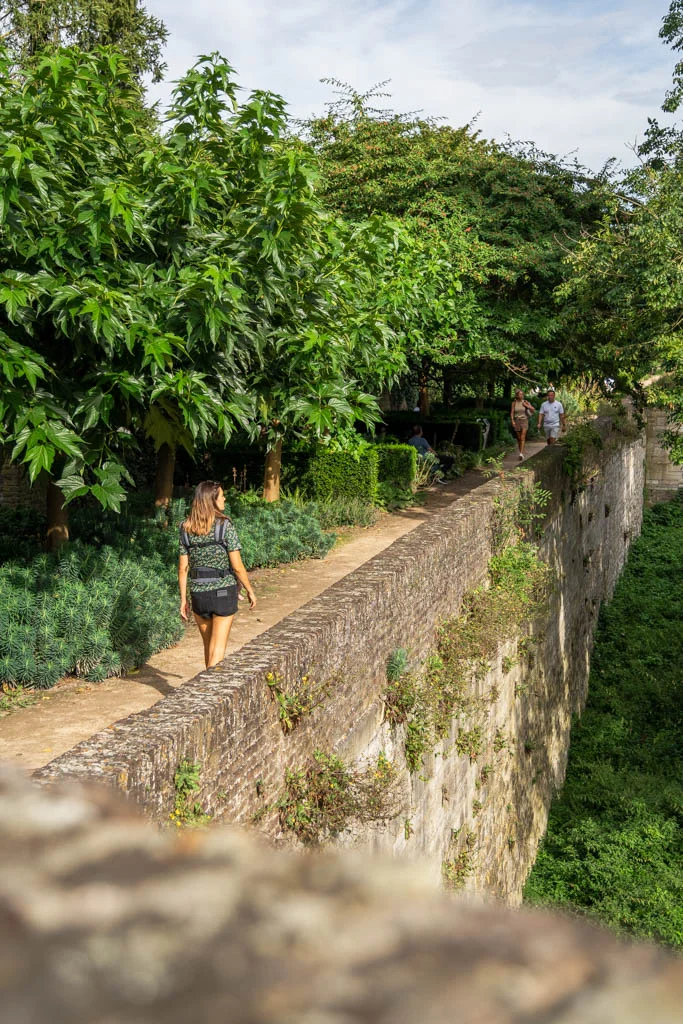
Walking through the city park, you’ll come across various remains of the second medieval city wall with watchtowers (2). The walk leads you along the top of one of those ancient walls. Feel free to imagine you’re a brave knight in armor, because that’s exactly where they were walking back in the fourteenth century!


Two rows of stately trees lead you along the Grote Looiersstraat further into the city. There, we encounter medieval city walls again along Klein Grachtje (3). These are part of the first medieval wall and are another century older. You can admire many flowers and plants both on the wall and against the facades of the houses in this charming little street.
We find even more history at the Bisschopsmolen (4) (Bishop’s Mill) from the eleventh century. This water mill is still operational and grinds grain for the traditional bakery located next to the mill. Inside the mill, you can watch the mechanism turn while the delicious scent of fresh pastries tickles your nose. Don’t hesitate to try a piece of Limburg vlaai in the tasting room!


Via another water wheel, the Leeuwenmolen, we walk into the eastern part of the park. We cross the Jeker a few more times and end up at the only remaining city gate in Maastricht and also the oldest of its kind in the entire Netherlands, the Helpoort (5). Inside, you can visit a fortification museum, and don’t forget to pose by the five cannons lined up around the wall.
Wyck across the water
Time to discover a new part of Maastricht! Via the Hoge Brug (6), we cross the Maas to Wyck, a hip, bustling neighborhood bursting with coffee bars and vintage shops. The bridge is unique because it has no pillars in the water and literally hangs above the Maas. This way, shipping is not hindered. Because of the necessary clearance height, they opted for a so-called ‘lazy staircase’. When you climb it, you’ll immediately know why it’s cursed by many locals…


In Wyck (pronounced “Wiek”), we end up at Plein 1992 (7). This square isn’t very special, but there’s a nice fact attached to the name. It is named after the year an important EU treaty was signed in Maastricht, which finalized the arrival of the euro. On the square, you can look for several bronze tiles with the euro symbol.
Take a nice stroll along the pedestrian-only Stenenwal for a beautiful view over the Maas, but also wander through the narrow, cozy streets of this neighborhood. Kattenstraat is one of our favorites because no matter how narrow the street is, every facade is decorated with plants or small trees.


Eventually, you walk via the Wycker Brugstraat, full of shops and popular restaurants, back towards the Maas and the oldest bridge in the Netherlands, the Sint-Servaasbrug (8). This was built in the thirteenth century with money from indulgences. Everyone who donated money for the bridge received an indulgence for forty days! Originally, the bridge had nine arches, seven of which remain today. For the most kitschy souvenirs, head to the kiosk at the end of the bridge.
The city center with three historic squares
We dive into the heart of the center, a mecca for shopaholics. We deliberately skip the typical shopping streets and two large malls, but that doesn’t apply to the elegant Stokstraat. Here you won’t find big chains, but rather luxury boutiques for clothing, jewelry, or chocolate. Oh, and tasteful wine bars! It’s mainly a chic neighborhood now, although it was once different and mostly workers lived here. We fell in love with the working-class boy Pieke oet de Stokstraote (9). With his dog Mao, he sits under a tree selling homemade soap. Today, touching the soap is said to bring good luck…


And then we walk around the corner and arrive at the smallest but coziest of the three historic squares in Maastricht’s city center: the Onze Lieve Vrouweplein (10). The numerous terraces here are never empty. It’s a pleasant place to relax under the trees and in the shadow of the basilica. You can visit the latter, and many tourists light a symbolic candle there.
The Bredestraat then brings us to the giant, tree-lined Vrijthof (11). This must be the most famous place in Maastricht. The square serves as the backdrop for countless events, such as concerts, carnival celebrations, and the annual Christmas market. The terraces here are also very popular. This is the place to be for anyone who enjoys ‘people-watching’, as there’s a lot of activity between the tables. Finally, take a look at the Sint-Janskerk. Its beautiful red color especially appeals to us.


Near the Vrijthof lies the most beautiful bookstore in the country, Boekhandel Dominicanen (12), located in the Dominican Church. You read that right: this is an authentic, 13th-century Gothic monastery church filled with books. You don’t have to be a bookworm to find this impressive. Moreover, you can enjoy coffee and cake at the former altar. An experience in itself!


A city walk isn’t a city walk without visiting the Markt (13). In the middle of Maastricht’s Market Square stands the city hall with its tower. It houses no fewer than 49 bells! Every Wednesday, the city hall is surrounded by market stalls with vegetables, fruit, fresh fish, or local products. Every Saturday, there’s a flea market. As you can tell, it’s a very lively scene!
The Staten and Sphinx Quarters in the north
We leave the crowds behind again and opt for smaller streets and passages. We’d like to introduce the Brandweerkantine (14). Until the mid-1990s, fire trucks drove in and out of here daily, but now it houses a restaurant, among other things. If you’re enjoying breakfast, lunch, or dinner on the terrace, take a look up, because the old fire tower is still there.
Through even more shortcuts, we end up in the heart of the Sphinx Quarter. Factories were located here during the industrial era. The old factory buildings have recently been upgraded and given new functions, such as a cinema or interior design shop. Take a walk through the Sphinxpassage (15). This is a 120-meter-long gallery where you can learn everything about the Maastricht ceramics industry. And maybe the Bolt rooftop bar is also for you?


This eventually brings you all the way to the north of the city at the Bassin (16). Several restaurants and cafes are located around this small inner harbor, where you can watch the boats sail in and out. Now the harbor is only used for pleasure craft, but it was once an important link for the nearby factories.
The city’s rugged backyard
From the Bassin, we follow a section of the Zuid-Willemsvaart, the canal that runs all the way to ‘s-Hertogenbosch. We naturally arrive at another remarkable spot: De Krul (17). This is a former exit of the Noorderbrug that now serves primarily as a viewpoint and is also used as a showcase for various art forms. Definitely worth the climb!


Suddenly, we’ve walked into the Frontenpark (18). As you can see, this isn’t a typical park with neat lawns and nicely planted shrubs, but rather a wild nature and landscape park. We walk between and on top of eighteenth and nineteenth-century fortifications, such as bastions and bunkers. We also discover traces of the industrial past. Who can spot the chimney of the former rubber factory, for instance? Or the gas cylinder of the old coke factory? Through years of neglect, nature has been given free rein here. Just the way we like it!
And so we end this city walk through Maastricht just as we began: in the green. Hopefully, you enjoyed it as much as we did!
placeswithoutdoors.com
Maastricht City Walk
Staying overnight in Maastricht
There’s certainly no shortage of accommodations for a relaxing stay in Maastricht! Hotel Monastère is a very stylish hotel. You’ll sleep in a 14th-century monastery near the Market Square. Boutique Hotel Sint Jacob is also located in a historic building. Partly due to its location just 100m from the Vrijthof, this is also an excellent choice.
Our personal favorite is located right near the central station—handy! In the hip Wyck district, we found the equally hip Green Elephant Hostel. You can choose a private room or go for the social vibe of a dormitory; one option is even more budget-friendly than the other. The hostel has its own restaurant, several wellness facilities, and—get this!—even a special hiking package!